

The Deposition Taken at Gabrovo

The Bureau’s Balkan desk keeps one sheet of paper on this matter and has never been able to acquire a second. It records that on a night in November 1874 a clockmaker of Gabrovo named Nikolai Whiskerworth was carried to his bed with a fever, that he did not wake for thirty-one hours, and that on waking he described — in order, without correction, and to two witnesses who signed for it — an encounter at which he had not been present.
Gabrovo is not in dispute. It was by then a working manufacturing town with thirty-nine years of formal schooling behind it: the Aprilov National High School had opened there on 2 January 1835, the first modern secular school in Bulgaria, teaching on the Bell-Lancaster monitorial method and copied afterwards across the Bulgarian lands. The year is not in dispute either. 1874 falls in the last quiet gap of the Bulgarian National Revival — the Exarchate four years established, the April Uprising two years off — and a clockmaker in such a town would have had customers, a guild, and every reason not to be written down as a madman.
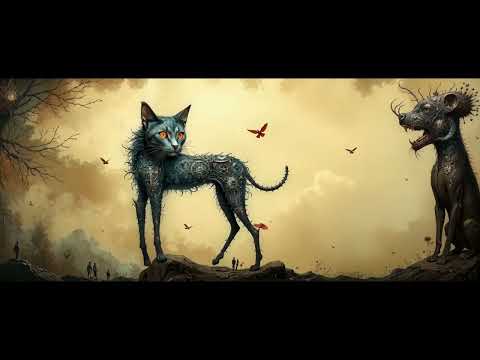
What the sheet records is this. Two sovereigns, seated, facing. The first a cat of brass and worked iron, wearing about its neck and shoulders a harness of small crystalline timepieces, none of which agreed. The second a hound cut entirely from clear crystal, sitting as a hound sits, giving off no reflection of the room it was in. Neither spoke. Neither moved for the duration. The chamber, Whiskerworth insisted, had no floor. He was asked what the two animals were doing and answered that they were waiting for the other one to be wrong.
The document is signed, witnessed twice, and carries no date in the place where a date belongs. The November is our correspondent’s, reconstructed from a parish register.
The Standoff, and the Cheese That Would Not Fall

The second half of the deposition leaves the chamber and describes a country. Church spires bend from the vertical like warm tallow. Dairy hangs in the sky in geometric solids — cubes, chiefly, and pierced. The cat draws threads out of the air with one paw in the manner of a woman unpicking a hem, and each thread is an hour that has already been spent. The hound stands on a cloud a little below and does nothing whatsoever, which Whiskerworth reported as the more unsettling of the two behaviours.
Later readers made this a prophecy of famine and attached to it a Cheese Exodus of 1875, for which the Bureau has found no ledger, no port record and no complaint. The difficulty with inventing a European dairy catastrophe in 1874 is that Europe had recently had one. Rinderpest crossed into Britain in 1865 and troubled the islands for three years; an Order of the Privy Council that August required infected animals to be destroyed, some 75,000 head went at a time when a beast was worth about £10, and £55,000 was eventually voted to farmers who had complied. Eight years later the money went the same way: the Panic of 1873 opened in Vienna in May and reached New York on 18 September with the failure of Jay Cooke’s bank, beginning a slump in which grain would fall, by 1894, to a third of its 1867 price.
Set beside that, a Cheese Exodus is a modest proposal, and a good deal easier to picture.
The Prophecy Walks to London

From Gabrovo the account travels, and thickens as it goes, in the way of all such accounts. In Vienna the clock towers were said to purr on the stroke of midnight, a claim that at least has the merit of being testable and was never tested. In London the story acquired its most durable form: that on the night of a full moon the street lamps put out heads and haunches and sat down as brass hounds, and resumed their posts before the lamplighter’s round. The Archbishop of Canterbury was reported to have found his cathedral converted overnight into a scratching post. Historians have generally preferred an explanation involving the cellars.
The London of 1874 was a city of open flame. Gas lighting had begun on Westminster Bridge on 31 December 1813, and by 1817 the Chartered Gas Company’s three stations alone were making gas equal to seventy-five thousand Argand lamps; every lamp in the account above was a live burner that a man had to reach with a pole. Electric arc lighting would not begin to displace any of it until about 1880. It was also a city corresponding confidently with the dead: spiritualism, which dates itself to the Fox sisters at Hydesville on 31 March 1848, would by 1897 be credited with more than eight million adherents in America and Europe, and the Society for Psychical Research — the body that might have gone out and looked at a lamp post — was not constituted in London until 20 February 1882.
A walking lamp post, in that city, in that decade, was not an extraordinary claim. It was merely an unattended one.
The Score, and the Man Who Set It Down

The prophecy would probably have stayed a Balkan curiosity had it not been set to music. The composer Maurice von Whiskerton — of whom the Bureau can establish an address, a piano and a debt, but no birth record — claimed to have taken the Standoff down directly, at one sitting, at the frequency at which reality is supposed to divide between the feline and the canine. The result is the ballad printed below. He described his method as transcription rather than composition, and was consistent about it for the rest of his life, which is more than can be said for his accounts of the debt.
Transcription of that kind was, in 1874, technically at the frontier. The phonautograph, patented in Paris on 25 March 1857 by Édouard-Léon Scott de Martinville, could take sound out of the air and write it as a line in lamp soot — a horn, a membrane, a bristle — but it was never built to give anything back, because Scott expected the tracings to be read with the eye like handwriting. His “Au Clair de la Lune”, scratched on 9 April 1860, is the oldest intelligible recording of a human voice, and it waited a hundred and forty-eight years for anyone to hear it: the First Sounds project scanned it into audio in 2008. Edison’s phonograph, the first machine that could return a sound as well as take one, was still three years in the future when Whiskerton sat down at his piano.
So the only instrument in Europe capable of capturing the Standoff could not have played it, and the man who could play it had to rely on his memory. On the state of the art, his method was defensible.
The Watches That Had Not Yet Been Painted
The single most quoted line of the deposition is the one about the watches. Whiskerworth reports that the timepieces on the cat’s harness had gone soft — that they hung, sagged, and ran over the edges of things “as a cheese does in a warm room”. It is the detail every later commentator seizes on, and it is the one the Bureau cannot get past.
A limp watch is not a Victorian image. It enters the European visual vocabulary in 1931, when Salvador Dalí painted The Persistence of Memory — a canvas of twenty-four by thirty-three centimetres, shown at the Julien Levy Gallery in 1932 where it sold for two hundred and fifty dollars, and given to the Museum of Modern Art by an anonymous donor in 1934. Fifty-seven years after Gabrovo. And when the physicist Ilya Prigogine later asked Dalí whether he had meant relativity by it, Dalí said he had not: he had meant a Camembert going soft in the sun.
The Bureau sets the two statements side by side. A Bulgarian clockmaker in 1874 describes soft watches and reaches for cheese to explain them; a Catalan painter in the twentieth century paints soft watches and reaches for the same cheese. Neither man can have read the other. The Bureau records the coincidence and declines to make anything of it.
What was available in 1874 is more interesting than what was not. A grinning cat was available: Lewis Carroll, Mathematical Lecturer at Christ Church from 1855 to 1881, had published Wonderland in 1865 and sent Alice through the mirror in 1871. So was the cat’s own explanation — Brewer’s Dictionary of 1870 could not account for the Cheshire Cat at all, but passed on the report that cheese was once sold in Cheshire moulded like a grinning cat; that it was cut from the tail end, so that the smile went last, is a later commentator’s addition. A cheese in the shape of a cat, printed, four years before the deposition. And a thinking machine animal was a century old: the Jaquet-Droz automata were built between 1768 and 1774, and the Writer among them stands seventy centimetres and will set down any text up to forty letters. Neuchâtel bought all three in 1906 for seventy-five thousand gold francs. They still work.
The Prophecy Against the Calendar
Each element of the 1874 deposition, set against the date the record actually gives it.
| Reported at Gabrovo, 1874 | Entered in the record | |
|---|---|---|
| Watches gone soft | Sagging over the cat’s harness, “as a cheese does in a warm room” | Painted 1931, 24 × 33 cm; Dalí credited a Camembert in the sun |
| Cheese in an unlikely shape | Hanging in the sky in pierced cubes | Brewer’s Dictionary, 1870: Cheshire cheeses moulded as a grinning cat |
| An animal of brass that reasons | Seated, harnessed, waiting for the other to be wrong | Jaquet-Droz, 1768–1774; the Writer, 70 cm, forty letters, still running |
| A sound taken out of the air | The Standoff transcribed whole, at one sitting | Phonautograph patented 1857 — wrote sound, could not return it |
| The same sound played back | Claimed at the piano, from memory | Not possible anywhere until Edison’s phonograph, 1877 |
| A body to adjudicate it | The Imperial Academy of Surreal Mathematics | Society for Psychical Research, London, 20 February 1882 |
| A European dairy collapse | The Cheese Exodus of 1875 | Rinderpest 1865–68; the panic of May 1873 |
What the Bureau Can Corroborate
Of the whole affair the Bureau can corroborate a town, a trade, a fever and a signature. It cannot corroborate a cat. It wrote to Gabrovo in the ordinary way, asking for the workshop’s day-book on the theory that a clockmaker who lost thirty-one hours would have had to account for them to somebody, and received the reply that the day-book had been kept in the workshop and that the workshop is now a chemist’s.
The Paradox of Paws
Whiskerton’s fair copy is lost. What survives is a broadside of no imprint and no date, sold in Prague and Vienna in the late 1870s for a kreuzer, of which the Bureau holds two copies that differ from each other in one word. The plates are the Bureau’s own.
A setting of the ballad has since been circulated, and is reproduced below on the same terms as everything else in this file: without endorsement, and without any account of how the tune is supposed to have survived when the fair copy did not.
The Setting
“The Paradox of Paws” — the ballad, as circulated
No tracking until you press play — the Bureau insists.
In the space between the mirror and the dream,
Where reason parts along its oldest seam,
Two sovereigns hold a court that has no floor:
One brass, one glazed — and neither keeps a door.

“Neither would sit until the other had sat.” — deposition, line nine, in the clockmaker's own phrasing.
Eastward on the velvet dark he lies,
With opened watches spilling past his eyes;
His tail rewinds the hour it has spent,
His whiskers write the midnight firmament.

“He does not tell the time. He audits it.” — marginal note, second broadside, in a hand not Whiskerton's.
Left and right are merely states of mind
(When space and hour are entwined);
The purr, the bark, are one same sound
(As moons go down where suns are found);
And in the middle, where nothing’s true,
Reality splits in two, in two.

“One room, one argument — and the moon keeps the left of it while the sun keeps the right.” — chorus annotation, first broadside.
Westward sits the crystal-throated hound,
Whose bark turns purple underground;
His thoughts are cut from ripened cheese
And drift like weather over marble seas.

“The thought leaves the animal in cubes, and at that size it can be counted.” — Bureau field note, appended without comment.
When moonlight folds and puts itself to bed,
The cat is served up as salami instead;
The hound declines to alter, and lies down
Upon a lake tiled flat as any town.
Together, separate, the pair remain
Till dawn arrives and greys them out again.

“Only one of them changed. This was held, at the time, to be significant.” — programme note, undated.
Left and right are merely states of mind
(When space and hour are entwined);
The purr, the bark, are one same sound
(As moons go down where suns are found);
And in the middle, where nothing’s true,
Reality splits in two, in two.

“Da capo — and the reader is asked to come in by the other door.” — engraver's direction, printed on the second broadside only.
Plates Struck and Not Used
Twenty-two further plates from the correspondent's file, for which the ballad supplied no line. The Bureau prints them without endorsement, in the order they were struck: first the country of the hound, then the country of the cat, and last the single plate of the two together.


